
Hello and welcome to Pictures for the End of the World, a conversation series with photographers, editors, curators, writers and others from the photographic world about the pictures that stay with us and why they matter.
Each guest is invited to imagine a simple scenario: the world is ending, and they have one final evening with a small collection of photographs, what do they choose?
Drawing from their own work or that of others; they select the pictures they would want beside them and reflect on why those images matter. The answers are rarely about the end of the world itself. Instead, they become conversations about memory, influence, beauty, love, loss, history, family, and the pictures that continue to stay with us long after we first encounter them.
In an age of endless scrolling and infinite images, Pictures for the End of the World asks a different question: which photographs matter?
We have never had more pictures than we do right now, and, subsequently, we have never spent such little time with them. We live in an age of photographic abundance, every day encountering thousands of images, scrolling, algorithmic feeds, AI-generated pictures, photographs that disappear moments after they’re seen. And yet, despite this overwhelming abundance, there are a handful of pictures we carry with us throughout our lives, be it physically or mentally. Pictures for the End of the World is interested in those photographs. In a world increasingly concerned with production, this project is concerned with selection.
The pictures we save are often pictures that have already saved a place for themselves within us. I am reminded of my first time seeing The Ballad of Sexual Dependency by Nan Goldin, her seminal 42 minute slideshow of over 700 photographs. It was 2010, I was 18 years old and it was part of an exhibition at the Tate Modern titled EXPOSED: Voyeurism, Surveillance and the Camera. I leant against the wall for the full 42 minutes. Each picture I saw was a portrayal of a world outside of my own and one that I wanted to know. I saw love and pain and desire. It was a big moment in both my personal and professional life and one that has never really left me. I can occasionally feel the numbness in my arm from leaning so heavily into the wall on the voyage to discovery.

I am also reminded of sitting quietly in the corner of my photography diploma class back at college in 2007 when I saw a picture of a man called Ray and a cat flying across the room. It was the book Ray’s A Laugh by Richard Billingham and in it lay a deeply intimate series of pictures of life in his parental home. First published in 1996 to enormous acclaim, Ray’s A Laugh depicts his parents and their often chaotic lives under the influence of alcohol and poverty. It is stark and raw and I found myself as a 16-year-old sitting alone with the book unaware of what I was feeling, but with a real urge to make sense of my response. I was new to seeing pictures like this, so raw and intimate, yet, it felt so familiar? The rooms in the house were not dissimilar to those that I grew up in and these people with seemingly vibrant and chaotic characters are much like those that raised me.
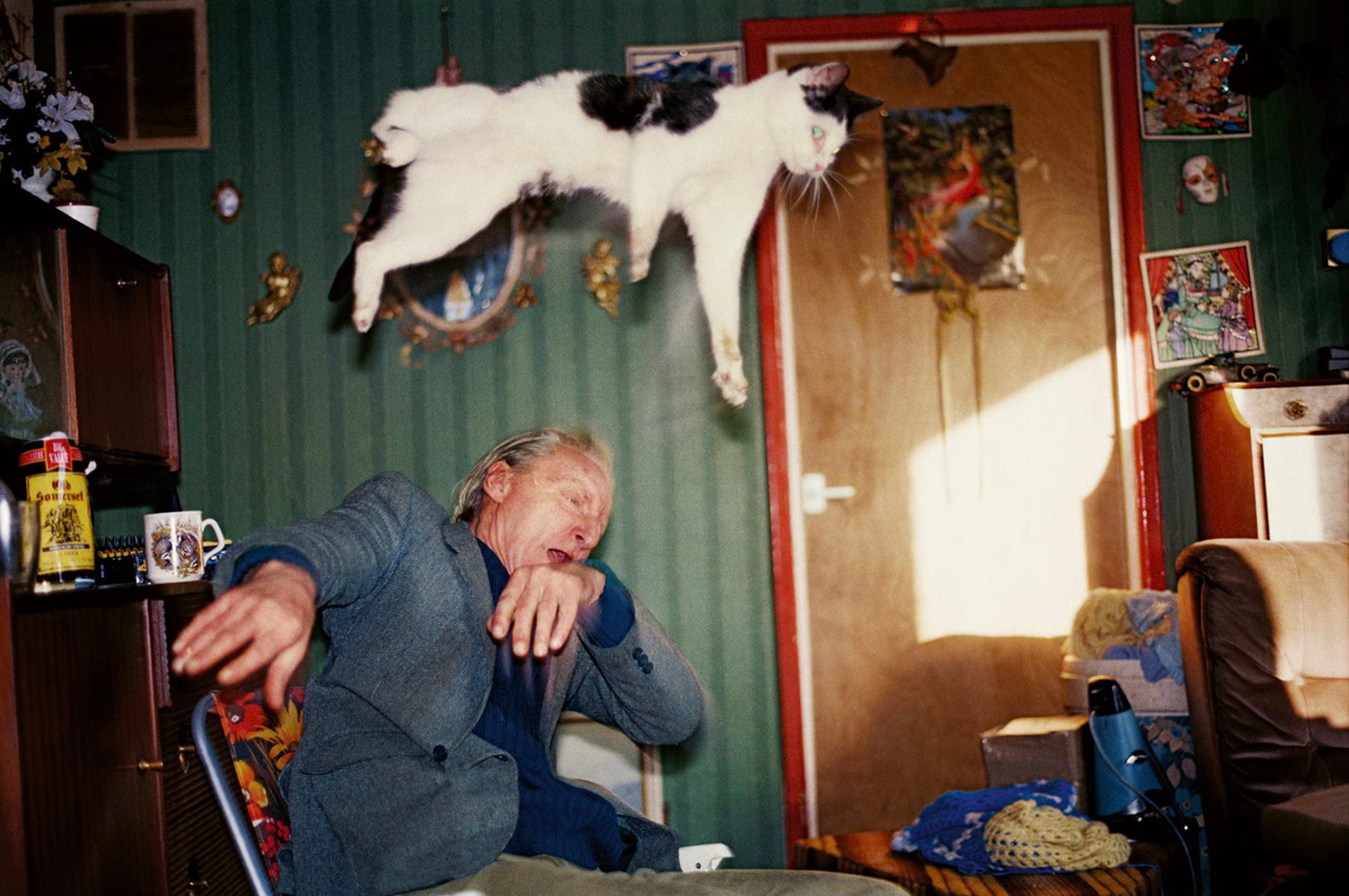
Years later, I can still recall those encounters with surprising clarity. Not because they were the greatest photographs ever made, nor because they occupy some fixed place in the history of the medium, but because they stayed with me. Perhaps they do occupy a fixed place elsewhere: in the history of my own life. They became part of how I understand photography, memory, and perhaps even myself. And so, these works by Goldin and Billingham would undoubtedly find a place among the small collection of pictures I would want beside me at the end of the world.
That, ultimately, is what Pictures for the End of the World is interested in. To imagine the end of the world is simply a way of stripping everything else away. There is no audience left to impress, no market left to serve, no reputation left to build. What remains are the pictures that, for some reason, matter.
The pictures we might choose at the end are often the ones that have accompanied us throughout our lives, or remind us of people we have loved, places we have known, moments we have lived through, and ways of seeing that changed us. Perhaps they became small records of our experiences, our values, our curiosities, and our memories. What would these pictures say about the life you had lived? And what might they reveal about what it means to be human?
Pictures for the End of the World begins with a simple curiosity: what are the photographs that have stayed with us, and why?
Please join us as we attempt to learn why.
Love this idea, can’t wait to see what enfolds x